Category: Blog


  • Does Prayer Change Things?

    Does Prayer Change Things?

    You may hear the phrase “What’s the use of praying?” from those who are in dyer or frustrating life positions. It’s a good question though and it is often asked when examining how we relate to God. If God is an all-knowing God and all-powerful knowing the past, present and future, how are prayers changing anything?

    I think it’s important first to look to the Word to see why God doesn’t change his mind. Have you ever had to rethink a plan or an answer? When you tell someone, “I have a better idea” or “I was wrong, this is a better idea”, we admit that our first idea, plan or assumption was not the correct one. If prayer changed God’s mind, he would be admitting the same and as an all-powerful, all-knowing God, his first statement is always correct just by his very nature.

    Second, if what we prayed for was a better option, it would place our intelligence above his or even if we didn’t have the better option, he would submit to our wants instead of his own perfect will. Granted our request means our solution would be higher than his. We often think we know better than him but remember, we have a limited view of life around us as he is able to see everything in one moment.

    This leaves us asking what prayer is actually for? Prayer has multiple functions but most of all, it reinforces our relationship with him. Often we base our connection to him by how many prayers he answers, but God is relational. He wants us to commune with him through prayer for us to worship him but also share our thoughts and feelings. When it comes to praying for something specific, knowing we won’t move God and that his will is perfect, prayer conditions me to accept his will, no matter what it is. That’s a tough pill to swallow as human beings as we are self-sufficient and ask for help only when we need it. Have you ever had a prayer not answered and you were glad it wasn’t? That’s God’s will at work. He saw what was ahead and closed the door. Problems arise when we force the door open because we know better. Only then do we realize he was right all along.

    Make prayer a part of your every day and take note of the differences you see in your life.


  • Do You Have Faith Like the Centurian?

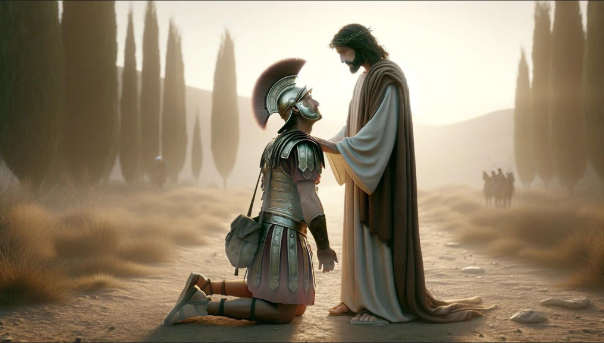
    Do You Have Faith Like the Centurian?

    But the centurion replied, “Lord, I am not worthy to have you come under my roof, but only say the word, and my servant will be healed. For I too am a man under authority, with soldiers under me. And I say to one, ‘Go,’ and he goes, and to another, ‘Come,’ and he comes, and to my servant, ‘Do this,’ and he does it.” – Matthew 8:8-9

    In the time of Jesus, Rome ruled all of Judea. Capernaum (located on the northwest shore of the Sea of Galilee), was a city chosen by Jesus to be his home after being driven out of Nazareth. It was also the location for one of The Lord’s most illustrative miracles when it comes to faith.

    Matthew tells us of a Roman enforcer of law who has a deep need. To the surprise of those around him, the soldier without prompt, recognizes Jesus as a healer, but his thoughts travel beyond what he had seen Jesus perform. The words of the centurion, “For I too am a man under authority, with soldiers under me” sounds strange within his request but it holds significant weight. At the time of Roman occupation, all centurion commanders were placed in a specific region for the reason of keeping order. The centurion led a centuria, a small number of troops (around 100) that existed within a larger number of troops, nearly 6,000, called a legion. In the hierarchy of Roman military, the centurion reported to a first-ranking centurion who in turn reported to a legate, a modern-day equivalent of a general-officer. From there, each level of rank reported to their superior (up to the emperor), making them accountable for every action or in-action they took while on duty. 

    Like himself, the centurion did not see Jesus as a stand-alone individual, but instead a person who was held accountable to someone, just as he was. Astonishingly, the centurion acknowledged Jesus not only as healer, but as divine. In turn Jesus states in verses 10 through 12:

    “Truly, I tell you, with no one in Israel have I found such faith.  I tell you; many will come from east and west and recline at table with Abraham, Isaac, and Jacob in the kingdom of heaven, while the sons of the kingdom will be thrown into the outer darkness. In that place there will be weeping and gnashing of teeth.” 

    Jesus presented to the Jews a gentile centurion who had little knowledge of Jewish law yet recognized him for not only his ability to heal, but doing so under the authority of someone greater than himself.  

    The level of faith Jesus recognized the centurion having, is the same level of faith he requires for us to possess as well. The consequence (vv. 11-12) Jesus speaks of for the Jews unbelief stands for both Jews and Gentiles. His warning states that all who choose not to believe with their entire mind, body and soul, will be separated from God for eternity. 

    If you have not made that decision today, I encourage you to seek God and have him reveal to you the need you have for Jesus to enter your heart, mind and spirit. 


  • What Are First Fruits?

    What Are First Fruits?

    We hear the term in church or in Christian circles that God wants our “first fruits”. What does this mean? We see the first example of what God wants in the book of Genesis 4. Here, the Lord accepts the offering of Abel but not of Cain (4:5). Though we do not know why one was accepted over the other, we know Abel made an offering to God from the best of his flock (4:4) while Cain offered vegetation from the ground. Did God base his acceptance on “what” the men had to offer? No. Since all was God’s creation, and as he can produce anything he wants, the problem of Cain’s offering was his heart.

    When we look at the character of God throughout the scriptures, we see that he is not concerned with materials. As stated, God does not need anything from us materially, instead he wants us to place him first in our lives. This concerns our finances, our time, our efforts along with anything else we can provide for this world. We see this throughout the Old Testament as well as the New Testament.

    “What are all your sacrifices to Me?”
    asks the Lord.
    “I have had enough of burnt offerings and rams
    and the fat of well-fed cattle;
    I have no desire for the blood of bulls,
    lambs, or male goats. (Isaiah 1:11)

    Here, God no longer wants the sacrifices of his people (Jewish people) because they continued to sin and no longer held him in their heart, pursuing what is right instead of their own sinful desires. It is a larger subject to discuss but the role of the sacrifices as a whole was the expression of their love for God and their obedience. For generations his people fell into the pit of considering sacrifices as an act for the payment for sin, instead of reconciliation. Like our own personal relationships with one another, to reconcile is to make things right again. It’s a time of admitting fault with a yearning to reconnect. The sacrifice by the Jewish people was in the form of an animal, and not just any animal, an animal with the greatest value to them. Giving God what is of the greatest value with no hesitation meant he was first in their life, despite what they would give away. Even more sad, the people who held out, never allowed God to replenish and add to what they sacrificed to him.

    Later in the Gospels Jesus reiterated the same principle.

    Sitting across from the temple treasury, He watched how the crowd dropped money into the treasury. Many rich people were putting in large sums. And a poor widow came and dropped in two tiny coins worth very little. Summoning His disciples, He said to them, “I assure you: This poor widow has put in more than all those giving t0 the temple treasury. For they all gave out of their surplus, but she out of her poverty has put in everything she possessed—all she had to live on.” (Mark 12:41-44)

    “Don’t collect for yourselves treasures on earth, where moth and rust destroy and where thieves break in and steal. But collect for yourselves treasures in heaven, where neither moth nor rust destroys, and where thieves don’t break in and steal. For where your treasure is, there your heart will be also. (Matthew 6:19-21)

    What we provide God is where our heart is. Does this mean if we pay a bill before a tithe that God will not accept it? No. First fruits simply means that in our hearts we recognize all comes from God and our act of giving is not an obligation but an action that strengthens our relationship with God to keep him in front and center in our lives.


  • Discipleship…It’s What’s Missing

    Discipleship…It’s What’s Missing

    Scrolling through clips on social media this weekend, I came upon a church holding an event called “Star Wars and The Gospel”. Contrary to what most would assume, this was not planned for not for children’s ministry. A six-part series sermon for adult service examining the first six Star Wars movies and how the story parallels the story of Jesus.  Out of curiosity , I stayed tuned to see just how the church could link Darth Vader and Luke Skywalker to Matthew, Mark, Luke and John. Their church service kicked off with ten stormtroopers doing a dance number to a Taylor Swift song. I tapped the screen again just to make sure it was a church. I searched out the churches website and under “recorded sermons” listed past sermons using Pokemon, Game of Thrones, The Office, and Marvel to preach the Gospel message . Each video I clicked brought a deeper feeling of dread but no feeling of surprise. The quest for relevancy has been adopted by many churches over the past 25 years. Pastors who fail to focus on the spiritual development of their congregants have no choice but to resort to worldly standards to measure their church’s success. Much of it is done out of competition.

    What does this competitive field look like? Sadly, it models the business world. If church A has 1100 members and church B has 500, church B will take drastic measures to attract more people in order to measure up to church A. This type of competition occurs when churches no longer measure the success of their congregation by spiritual development but by attendance numbers. I was on staff church about ten years ago that considered playing secular music during service (Lynyrd Skynyrd, Bruno Mars, U2) to connect with those who who were not “churched”. I’m not sure how secular music would entice people to attend service and tithe their income but just their consideration of such a blasphemous act motivated me to resign. The experience only increased my desire to serve and advocate for more for discipleship in today’s churches. 

    I’ve found that gimmicks are only a part of the problem when it comes to a lack of discipleship. Many churches today (void of gimmicks) cannot define discipleship, let alone implement it. Amny tie the concept of discipleship to Bible Study or Small Group Ministry. Those these can be used in the discipleship process, they are by far not a substitute for mentorship and teaching that educates and enriches another individual. What’s needed is a mature Christian taking time to explain and guide a new believer by spending time with them. Introducing them to Christian Disciplines (prayer, serving, daily personal Bible study) that will help them grow in Christ. Discipleship is developing one person at a time individually, and a congregation, corporately. While gimmicks attract and entertain, those who are entertained will eventually become bored and leave if they are not spiritually invested. The average number of weekends a family will attend church has decreased in the past 20 years from three to only one weekend per month in the past 20 years. Naturally, when spiritual development and connection is not present, families will find other activities to fill up their Sunday.

    What does a church that values discipleship look like? There are some consistent traits and activities that exist in those who invest in their church members:

    1) Welcoming Environment: When you walk into a church, members should greet you and welcome you (not just the door greeters). If warmly welcoming someone is not a part of the culture, most likely spiritual discipleship is not either.

    2) Discipleship Classes: Bible Studies and Small Groups are great for learning and creating community but even though some churches classify them as an element of the discipleship process, they are not. Discipleship concentrates on teaching about the faith, principles of the faith and instruction on how to grow in the faith. Studies and small groups are great to attend but don’t accept them as a substitute.

    3) Personal Time: Discipleship is about time and attention. It’s the ability for a believer who has been in the faith for a long time, to meet with a new believer and help them along the way. It should be someone who models how a believer acts and lives. Discipleship teaches how to live each day in the spirit.

    4) Pastor Focus: As stated before a pastor needs to make discipleship the highest priority for their flock. When speaking with a pastor and asking about discipleship, the pastor should know what the church’s discipleship path is. If they begin to mention ways to connect with one another instead of learning and developing, it’s a good sign the church (not to be critical) is absent of a discipleship program.

    These are not  set in stone but only what I have experienced when deciphering between a spiritually healthy church and a spiritually empty one. The good news that you have the ability to learn about the faith on your own as well. Many authors have developed materials and studies to assist a new believer in their walk. Below are a few resources I recommend.

    New In Christ: A Simple Guide for New Christians by Scott Roberts. A great book that simply explains the first steps of a Christian such as learning about prayer, reading God’s Word and baptism.

    How to Pray and Read the Bible: A Guide for New Believers by Lee Ann Rubsam. A very short (40 pages) and inexpensive book that provides information for new believers about two of the most important aspects of walking with The Lord.

    New Believer’s Bible with Greg Laurie. The Bible is CONFUSING at first. Two testaments with many terms and stories that can be daunting to grasp. Greag Laurie who is a pastor of Harvest Church in California was not raised in the church. Instead he came to Jesus in his later teens (Check out the movie Jesus Revolution to watch his story). The Living Bible is a translation of the scriptures that is easy to understand. Along with Laurie’s inserted teaching, it’s great as a way to get familiar with The Bible.

    Growing In Christ: A 13-Week Course for New and Growing Christians. Easy to understand the promises of Jesus Christ along with answers to questions every believer has. I have worked with many new believers through this study, and I enjoy it each time. It’s only 80 pages but provides you a way to learn and engage your new Christian life.

    Learning comes day by day. The walk is much more important than the knowledge and memorization. I hope this post provides you some assistance in beginning the greatest journey you could ever encounter.


  • Are You Seminary Searching?

    Hello Friends,

    If you are thinking about ministry education, I hope this post can assist you in the decision-making process. Like most, I consider the reviews of others to help me when it comes to any kind of investment. My journey has been full of twists, turns and lessons, so hopefully some of the things I learned along the way can help…

    Accreditation:  Accreditation is important as it determines that an institution is professional, reputable and up to standard. Often employers look for potential employees who have completed their education at an accredited college. Choosing a college without well-known accreditation is risky and can leave a student with a degree that is not useful.

    Diploma Mills: In your search you may encounter what are called “Diploma Mills”. These are scam programs that advertise heavy but offer worthless degrees. It’s best to stay away from them.

    A diploma mill can be spotted a few ways:

    • Poor website quality.
    • No pre-requisites required (no transcripts or prior education needed).
    • Vague contact information.
    • Limited available programs.
    • No accreditation or is accredited by an agency that has no affiliation with any reputable school(s).
    • Coursework that does not require any textbooks (physical or electronic).

    Denominational Colleges: Christian colleges are either denominational or non-denominational. Colleges that are denominational are operated by denominational organizations (i.e. Southern Baptist Convention, PC-A/USA, United Methodist). Often denominational colleges will list their affiliation on their website but if not, you can contact the school to find out.

    On-Campus / Distance Learning / Hybrid Formats: Many colleges today offer online options for learning, but some do not while others offer programs that are part distance-learning and part on-campus. It’s a good idea to check before moving forward.

    Degree Employment Potential – Like secular colleges, some degrees that are offered by Christian colleges do not satisfy requirements for specific career positions. The best way to make sure you are on the right path with obtaining the proper education and credentials for a position you desire is to speak to someone already in the field you want to enter. 

    I hope this information is able to assist you in your search.


  • BibleTalk.TV Website

    BibleTalk.TV Website

    BibleTalk.tv is a Bible teaching website from the Church of Christ that provides media for those who want to know more about the Bible. Developers created the site in a well-organized and simple to follow format for general Bible study. For those who want to learn, BibleTalk.tv provides over 70 different series on topics ranging from Old and New Testament books to studies on marriage and family as well as church growth material. This material is arranged into 5 individual study plans geared for beginner to advanced study. All of this and more, free to view with no requests for personal info or money. Enjoy !  – Dominic 


  • Church Hunting? Some Additional Points to Consider

    Church Hunting? Some Additional Points to Consider

    Everyone who is looking to join a church has a personal list of what they (and maybe their family) are looking for.

    Often people look for the normal things (in no particular order)..Children’s Ministry? Adult Bible Study? Small Groups? Good Sermon? Good Music? Service Opportunities? 

    Some people will make spontaneous on-site visits while others will research all they can before visiting. For this post, I want to list a few additional things to think about when looking for a church community. 

    1. Denomination: Catholic or Orthodox parishes are pretty straight forward when it comes their church name, but some Protestant churches have chosen to take on a more generic name to create a wider appeal to the community. For example, First Baptist Church of XYZ may have changed their name to XYZ Community Church. The name may have changed but the church will keep their affiliation. Churches are not looking to bait and switch as much as they want people to feel welcome when they enter. It’s important to look into a church’s affiliation (if there is one) and determine if the denomination’s beliefs match yours. 
    2. Service Limitations: In relation to a church’s denomination / affiliation is the church’s position on key issues. These key issues can determine how a person can serve as a member. For example, a strict conservative church may not allow a woman to teach, while a more relaxed conservative church would. If a divorced individual joins a church with the aspiration of being a deacon or an elder one day, they may want to check and see how the church stands on the issue before joining. These issues are often not listed on the church’s website so an individual would need to speak to a pastor or elder/deacon about the issue. 
    3. Pastoral Availability: A Senior Pastor’s job is difficult and can be overwhelming consider the amount of work that needs to be done during the week. Often in very large churches, the pastoral staff (co-pastors, executive pastors, ministry pastors) help alleviate the pressure by performing pastoral duties including hospital visits and counseling. Though support is necessary, it could also create distance between members of the church and its leader. If close access to the Senior Pastor in times of need is important to you, find out how the pastoral staff functions and who would respond to your need if requested. 
    4. Bible Carriers or Screen Readers: It may sound trivial but for many it matters if a church encourages their members to bring their Bibles to service. This depends on the culture of the church and is often noticed when visiting for the first time. 
    5. Topical or Verse-by-Verse Preaching: Majority of sermons given by pastors today are topical. Pastors who preach topically will preach a single sermon or a series based upon a theme or one particular aspect of the Christian life (i.e. forgiveness, faith, prayer) and reference certain passages that act as the foundation for the message. Verse-by-Verse (or expository preaching) differs from topical as it moves through a book/chapter of the Bible with the pastor explaining what the verses are saying to us. A good preacher should be able to develop a good sermon from either method. If the church you are planning to visit has a live stream or recorded sermons available to the public (Youtube is popular) you will be able to see in what form the church’s pastor preaches. 

    Most important action that can be taken when searching for a church is to pray on it. Be confident that God will guide you to the community he wants you to be a part of. 


  • Quitting Your Bible Reading Plan? Here’s Why.

    Quitting Your Bible Reading Plan? Here’s Why.

    “Then he returned to his disciples and found them sleeping. “Couldn’t you men keep watch with me for one hour?” he asked Peter. Watch and pray so that you will not fall into temptation. The spirit is willing, but the flesh is weak.” Matthew 26:40-41

    It’s 2026 and many of us have quit some of our resolutions already. That weight loss goal? Frustration led to four pieces of pie. Working out? You can’t find the time like you thought you could. Reading the Bible in a year? You made it to Genesis 5 and gave up due to morning responsibilities. The problem with Bible Reading Plans is the manner in which we approach them. We often consider a plan of sorts and expect ourselves to depend upon the system in order to be successful. 

    Matthew 26:41 may not directly refer to resolutions but in an indirect way it does. Jesus makes the distinction between a human’s desire versus our nature. Our desire is to make a change in our life, but our flesh (or our very own nature) will eventually fail us. In verse 40 he addresses the apostles’ weakness of being able to stay awake and keep watch while he prayed in the Garden of Gethsemane. Their flesh caused failure.

    To solely blame our flesh is only partially correct, in my opinion. In the case of Bible Reading Plans, we don’t look any deeper than the “should”. No matter the reason was for walking away from reading the Bible, all roads normally lead to one root issue–definition. What is the Bible? I feel this is where the rubber meets the road. If we examine how we define the Bible, we will find out why we fail.

      Ask yourself the following:

    • WHY do I want to read through the entire Bible?
    • WHAT would reading the entire Bible mean to me?
    • WHY do I want to read the Bible within a specific length of time?

    Be honest with yourself. Are you attempting to read the entire Bible because it’s what you feel you should do? Are you reading it because it’s something you want to say you did in 2026? If you said yes to either of these, you are going to fail.

    My advice, STOP READING THE BIBLE…or at least reading it–to read it. The Bible is not a book. The Bible is divine–it’s supernatural. It’s God’s chosen medium to communicate with his creation. We tend to think that the Bible is God’s final word–case closed…but that’s not all it is. Yes, the Bible is God’s Word but it’s an active Word. God lives through it. He speaks to our lives through it. It’s not stationary where we read it once and obtain the knowledge we need. It’s a part of us. As Christ is abiding in us, so is his Word.  It’s continuous. Once we realize that we are connecting with The Lord through his Word each and every day, we will stop viewing the Bible as a novel found on a bookstore shelf. Understanding the Bible for what it is moves us to want to read it continuously for connection, not obligation.

    Instead of following a system, how about keeping a journal. Read through it slowly, at your own pace, while asking God to speak to you over what you read in his Word. Nothing delights him more. Notate the text. Mark it up. Create journal entries that you can look back on and recall what God said to you or impressed upon your heart. This is about relationship, not accomplishment. 

    I pray that your definition and consideration of his Word is transformed in 2026, and you will find growth not in a schedule but in a desire to grow closer to him every day.


  • Personal Inventory Never Hurts

    Personal Inventory Never Hurts

    And a scribe came up and said to him, “Teacher, I will follow you wherever you go.”  And Jesus said to him, “Foxes have holes, and birds of the air have nests, but the Son of Man has nowhere to lay his head.”  Matthew 8:19-20 ESV

    Jesus’ example to us throughout his ministry spoke of many of the necessary areas of sacrifice one must make to be a true follower. Such as what he said in Matthew 8:19 as he spoke to a Jewish scribe, our hearts alone determine if we are able. Scribes (writers in the Jewish faith) did fairly well financially. Scribes were highly skilled and well paid by Jewish leaders to record speech or recopy sacred texts without flaw. Here, the scribe’s desire is to follow Christ but without knowing, is ignorant to the level of self-sacrifice it will take to truly do so. Jesus knows the heart of the scribe and provides elements of nature to illustrate how a follower lives. His words “nowhere to lay his head” is not about the absence of a physical bed, as it is understanding that the world will not accept you if you become a disciple. Jesus wanted the scribe to realize that following him demands total surrender and total acceptance that the world we live in is not our home. Essentially, the scribe must have left behind all desires for earthly possessions and securities to walk a path many would not.

    Jesus’ heart was not for earthly fame and riches; the focus of his ministry was to bring glory to God and fulfill his will for the redemption of mankind. To lay his head would be to consider earth his permanent home. Jesus knew the scribe’s heart was not willing. As with the young rich ruler (Matthew 19:16-22), Jesus seeks those who hold no desire to sew into the life they are currently living but instead sew into the Kingdom of God.

    Does this mean we need to leave our families, sell our homes and give all of our money to charity? Absolutely not. We have to ask ourselves though, what is first in our own heart? Do we desire him above all? I often take a self-inventory and truthfully, I find elements of my life I hold above him whether it would be my career, my plans or even my family. It sounds extreme but I know that without him being my first desire, my family will not receive the love and support it needs from me to remain spiritually healthy.

    Maybe conduct a self-inventory and see where your heart stands. Self-reflection leads to growth. We become more self-aware of the roadblocks in our life that hold us back from growing in our relationship with God.


  • When We Feel Separated

    When We Feel Separated

    “They are not of the world, even as I am not of it. Sanctify them by the truth; your word is truth.”

    Unless you’re an introvert, almost everyone hates being an outsider. As humans, we have a desire to be a part of social gatherings and circles. We pursue relationships with those we are attracted to and inspired by in some way. Feeling accepted provides us a warm feeling, a sense of connection. So, when we feel we do not fit in with a social group, it hurts.

    I learned early in my Christian walk was that God is not concerned with us “fitting in”. He creates connections and places people in our path who become friends but providing us from others at any cost is counter to what he wants for our lives. In truth God sets us apart from others on purpose. This does not mean he requires isolation, but when we become his, he will not accept anything less than the very best for us when it comes to those who become a part of our social and support circles.

    As we are called to him, the Holy Spirit cleanses us and develops us. Despite the ongoing process, he continually draws us back to himself through spiritual conviction. Being a follower of Christ can be lonely, especially when we are separated from those God deems no longer fit to socialize with us, but during these periods of time, he desires to develop us further. Where we were once filled with selfish intentions that gave us a false sense of satisfaction, he becomes our satisfaction. God often replaces those who we lost with others who help us on our journey to become what God wants us to be. Others who he is developing as well by using us to support them in their own walk.